


English And Proud Of It
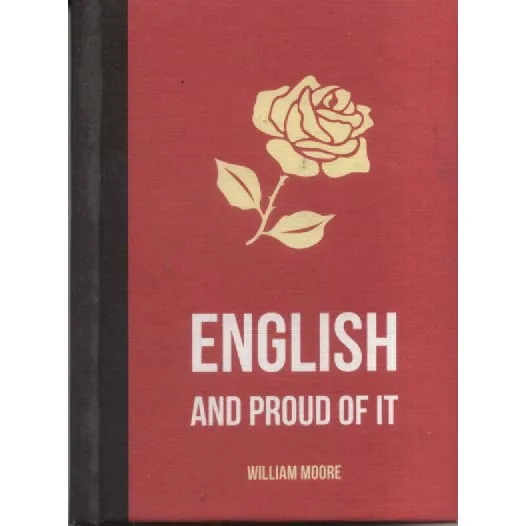
Publisher: Summersdale
Format: Hardback
ISBN: 9781849535212
English and Proud of It (2014) by William Moore
Summersdale | ISBN: 9781849535212 | Condition: As New
There comes a moment in every English person’s life when they find themselves standing in a queue, apologising to somebody who has just trodden on their foot, discussing the weather with a complete stranger and wondering whether it would be considered impolite to complain about the cup of tea they have just been served. At precisely this moment, they may begin to appreciate the extraordinary cultural inheritance into which they were born. In English and Proud of It, William Moore celebrates the peculiar, occasionally magnificent and frequently bewildering business of being English, a national identity built upon centuries of history, a stubborn attachment to tradition and an almost supernatural ability to remain emotionally composed while everything falls apart.
England is, after all, a remarkable country. It gave the world Shakespeare, Newton, Darwin, the Industrial Revolution, parliamentary democracy in its evolving form, cricket, the steam locomotive and the sandwich. It also gave the world Morris dancing, warm beer, motorway service stations, reality television and the peculiar conviction that a holiday is not complete unless one has complained about the weather, the food or the Germans reserving all the sun loungers.
William Moore’s affectionate celebration of Englishness offers an entertaining opportunity to contemplate the achievements, customs, characteristics and wonderfully contradictory habits of a nation that has somehow managed to influence the entire world while remaining profoundly uncomfortable with the prospect of introducing itself at a social gathering.
The English are a curious people. They are capable of astonishing acts of courage, extraordinary ingenuity and remarkable generosity, yet frequently struggle to inform a waiter that the soup is cold. They can organise vast military expeditions, construct enormous engineering projects and produce some of the greatest literature ever written, but place them in a room with an unfamiliar person and they may immediately begin discussing the possibility of rain.
Indeed, the weather occupies such an important position in English national life that it might reasonably be considered an unofficial branch of government. Rain is too frequent, sunshine is suspicious, snow brings the transport system to a halt and a temperature exceeding 25 degrees is treated as a national emergency. The ideal English climate would appear to involve a pleasant afternoon in late May, although this is generally scheduled to occur on a Tuesday while everybody is at work.
And then there is tea, that indispensable national institution without which the entire social structure might collapse. The English have developed an extraordinary ability to respond to practically any situation by putting the kettle on. Bereavement, financial ruin, industrial disputes, romantic disappointment, military setbacks and the unexpected arrival of relatives can all be addressed, at least initially, through the preparation of a suitable beverage. Whether tea actually solves any of these problems is debatable, but it does provide everyone with something to do while pretending that everything is under control.
Englishness is also inseparable from an abiding affection for eccentricity. This is a nation that has produced generations of inventors, explorers, naturalists, writers, collectors and determined amateurs pursuing interests so obscure that even their closest relatives cannot explain what they are doing. Somewhere in England, at this very moment, somebody is almost certainly cataloguing the history of municipal drain covers, restoring a Victorian lawnmower or compiling an exhaustive register of railway station lavatories. Such people are rarely regarded as particularly unusual, provided they do not make too much noise on a Sunday.
The countryside, too, occupies a special place in the English imagination. Rolling fields, ancient churches, winding lanes, village greens, country pubs and picturesque cottages represent an idealised national landscape which many people hold dear, even if they actually live in a suburban housing estate overlooking a dual carriageway. The English village remains a powerful symbol of tradition, community and continuity, although anyone who has attended a heated parish council meeting will appreciate that rural tranquillity can conceal levels of hostility normally associated with international territorial disputes.
The village fête is perhaps one of the finest expressions of this peculiar national character. Here, perfectly respectable adults devote extraordinary effort to competitions involving homemade jam, oversized vegetables, floral arrangements and the correct identification of mysterious objects in jars. Rivalries may last for decades, particularly when Mrs Henderson’s marmalade has defeated Mrs Pritchard’s for the third consecutive year. Yet everything proceeds under an atmosphere of exaggerated politeness, because openly admitting that one despises the jam judge would be considered frightfully bad form.
Then there is cricket, a game whose complexity has puzzled generations of foreigners and not a few English people. It may continue for five days, feature lengthy periods in which nothing particularly dramatic appears to happen, and conclude without either side winning. Naturally, this makes it one of the nation’s most cherished sporting traditions. The ability to spend an entire afternoon sitting in the sunshine watching other people stand in a field is regarded as a perfectly respectable use of one’s time, particularly if sandwiches and a flask of tea are involved.
Football, by contrast, provides the English with an opportunity to abandon their usual reserve and display emotions that would ordinarily require several years of counselling to uncover. An Englishman who has not expressed affection for his closest relatives in twenty years may be reduced to tears by a missed penalty, while a controversial refereeing decision can inspire levels of outrage seldom witnessed outside a parliamentary expenses scandal.
Of course, English history is considerably more complicated than a collection of charming traditions and sporting disappointments. Kings, queens, battles, revolutions, religious conflicts, scientific discoveries, industrial developments and imperial ambitions have all contributed to the country’s distinctive character. The English have repeatedly demonstrated an extraordinary capacity for changing the world, sometimes for the better, occasionally for the worse and frequently while insisting that they would much rather have stayed at home.
The English language itself is another magnificent national achievement, although its origins and development are so thoroughly entangled with the languages of other peoples that claiming exclusive ownership would be rather like insisting that a borrowed lawnmower had always belonged to one’s family. English has cheerfully acquired words from around the world, ignored its own grammatical conventions whenever convenient and developed spelling rules so inconsistent that teaching them to children occasionally resembles a practical joke.
Nevertheless, English literature remains one of the country’s greatest contributions to civilisation. From Chaucer and Shakespeare to Dickens, Austen, Hardy, Orwell and countless others, the nation has produced writers capable of examining the human condition with extraordinary intelligence, compassion and humour. It has also produced an apparently limitless supply of celebrity autobiographies, proving that literary achievement, like national character, is a somewhat uneven affair.
Perhaps the most endearing aspect of Englishness is its capacity for self-mockery. The English may be proud of their history, their institutions and their cultural achievements, but they also possess a longstanding tradition of finding the whole business faintly ridiculous. An excessive display of patriotic enthusiasm is liable to be met with suspicion, particularly if it involves public singing, emotional speeches or waving a flag without an obvious sporting justification.
Pride, in the traditional English manner, is often expressed through understatement. A person might regard their country as the finest place on Earth while describing it merely as ’not too bad, really’. A magnificent achievement may be acknowledged as ’quite satisfactory’, while a catastrophe of historic proportions might be dismissed as ’a bit unfortunate’. It is a wonderfully economical system of emotional communication, although it can create considerable confusion when dealing with people who prefer to express their feelings directly.
There is also the question of what it actually means to be English in the twenty-first century. The country has changed enormously over the centuries, shaped by successive waves of migration, cultural exchange, industrialisation, urbanisation and technological development. English identity is therefore not a single fixed collection of ancient customs, but an evolving mixture of traditions, influences and experiences. The resulting national character is far more interesting than any simple collection of stereotypes could suggest, although the stereotypes themselves remain an excellent source of entertainment.
A celebration of England need not involve pretending that everything is perfect. Indeed, complaining about England is arguably one of the most authentically English activities imaginable. The trains are late, the roads are full of potholes, the government is incompetent, the neighbours are making a dreadful noise and somebody has changed the packaging on the biscuits. Yet suggest to the average English person that they might prefer to live somewhere else, and they may suddenly produce a surprisingly extensive defence of their homeland.
There is something rather wonderful about this contradiction. The English are capable of criticising their country relentlessly while retaining a deep affection for its landscapes, traditions, institutions and peculiarities. They may grumble about the weather every morning, but after a fortnight abroad they begin missing the rain, proper tea, familiar newspapers and the reassuring sight of someone standing at a bus stop looking mildly disappointed.
Published by Summersdale in 2014, English and Proud of It belongs to the delightful tradition of light-hearted books celebrating national character, cultural identity and the everyday absurdities that make a country recognisable to its inhabitants. It offers an affectionate reminder that national pride need not always involve grand speeches, solemn declarations or arguments about historical superiority. Sometimes it is simply a matter of appreciating the wonderfully peculiar place one happens to call home.
It is the sort of book that makes an entertaining gift for the patriot who already possesses a Union Jack mug, a collection of commemorative royal wedding tea towels and strong opinions about the proper preparation of Yorkshire pudding. Equally, it may appeal to visitors attempting to understand why the English apologise when somebody else makes a mistake, insist that everything is ’fine’ when it plainly is not, and regard forming an orderly queue as evidence that civilisation has not entirely collapsed.
This 2014 Summersdale edition is offered in As New condition by Crappy Old Books, a bookseller that takes a certain patriotic satisfaction in rescuing perfectly respectable volumes
Keep browsing: See more Humour books Other books by William Moore
